Introduction PODs
Introduction PODs are a kind of POD used to introduce any cryptographic data structure into the POD system. This allows the POD system to reason about cryptographic data and cryptographic primitives that are not part of the POD system itself.
Examples of Introduction PODs are the Ed25519Pod and the EcdsaPod, both
of them allowing to incorporate their respective kind of signature schemes that
are not supported in the core of the POD system.
This allows the POD system to incorporate data validated by those
Introduction PODs, and recursively use it in future proofs combining them with
any logical reasoning together with other PODs.
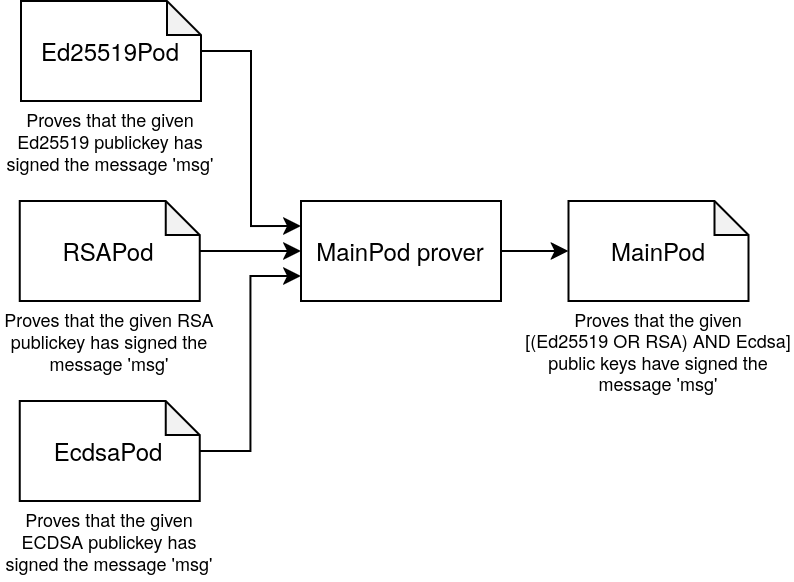
For example, we could have a scenario where we use 3 different Introduction
PODs (Ed25519Pod, RSAPod, EcdsaPod), to prove that a user controls an Ethereum
wallet AND a GitHub account. To do so, the user would produce a new MainPod
which proves that the user has signed a certain message with the given ECDSA key
(Ethereum wallet) AND with either the given Ed25519 key OR the RSA key (from
a GitHub account).
Interface
The interface of an IntroductionPod is just the one of the
Pod
trait, and by definition the IntroductionPod is expected to only output
Introduction statements (or None statements for padding).
An Introduction Statement is a Statement that uses an Introduction predicate
which embeds the hash of the verifier data of the circuit that generates it.
This way the statements generated by an IntroductionPod are self-describing.
When a MainPod imports a statement from an IntroductionPod, the circuit sets
the predicate of the statement to the Introduction predicate of that POD's
verifier data, so an IntroductionPod can't output statements of any other
predicate.
This means that as long as we fit into the Pod interface, the
IntroductionPod will fit into the recursive verification chain of the
MainPods.
Introduction predicates can be used in custom predicates; in
Podlang they are imported with
use intro name(args) from 0x<verifier_data_hash>.
Different configurations
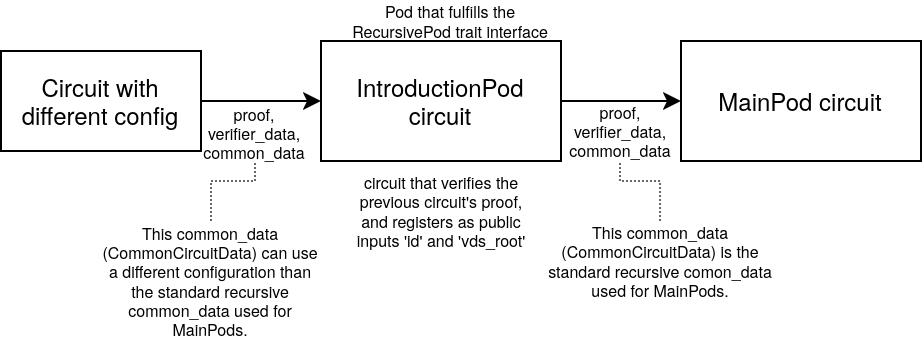
There are some cases, where the operations needed for the IntroductionPod
require a different circuit configuration than the standard recursive circuit
configuration that is used for the MainPods.
In those cases, we do a previous recursive step, where we verify the logic of
the intended IntroductionPod, and then the proof of this circuit is the one
verified in the real IntroductionPod.
This is done in order to be able to converge the different circuit
configuration shape (and thus different common_data) into a new proof that can
be verified with the standard configuration (used for the MainPods).
Notice that this is not a requirement for implementing a new IntroductionPod,
and if the IntroductionPod logic can be directly verified with the standard
recursion configuration, we don't need this previous recursive step.
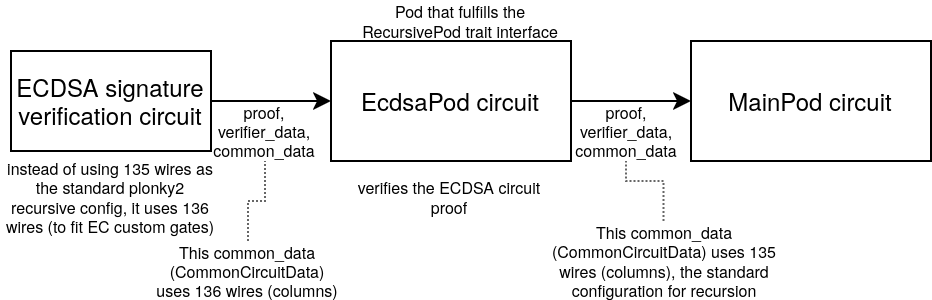
As examples of the two-recursive steps approach, we have the EcdsaPod and the
Ed25519Pod. Both of them require different circuit configurations that would
not match the one used for the standard recursion with MainPods. Therefore we
first generate a circuit proof of correct signature verification, and then this
proof is the one actually verified in the EcdsaPod/Ed25519Pod respectively,
not the original signature itself.
Examples of
IntroductionPodscan be found at the git repository github.com/0xPARC/introduction-pods.